Forest Fires

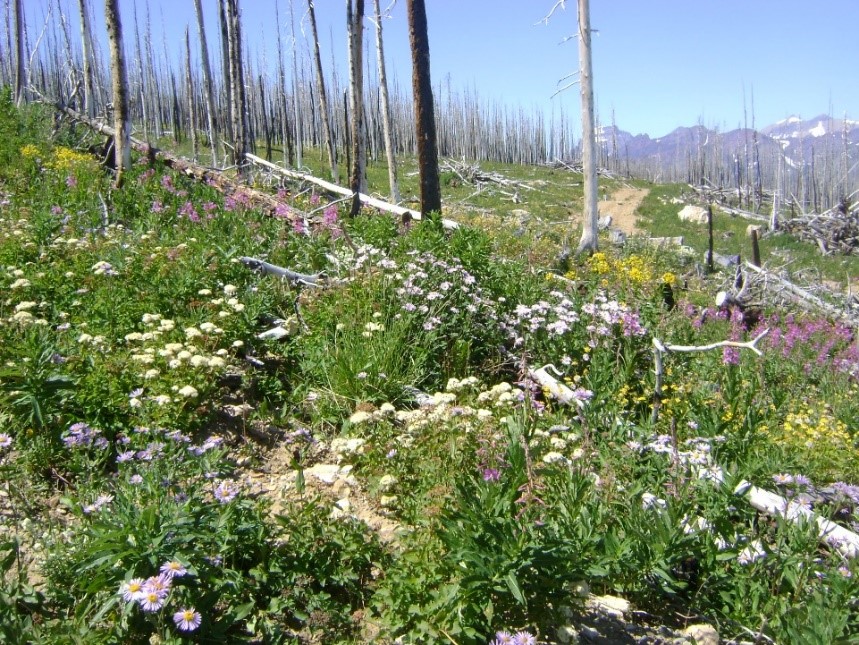
Forest fires result in what often looks like destruction – burned and blackened trees, charred ground, powdery ashes, hazy air, and the skeletons of little shrubs. However, fires are a transformative process within ecosystems. Healthy forests burn with regularity, which keeps debris and brush to a minimum, infuses nutrients into the soil, and reduces invasive species. Ecosystems are in a constant process of change. When change is stopped (usually by people), the system can get out of balance (and this is usually when we see the very severe fires).

While I was doing research on the effects of wildfires within a national park, I had many casual conversations with park visitors who commented on how awful the fires were and how they ruined the beautiful forests. From a snapshot in time – visiting the park for a weekend or a few weeks – the burned forests did look decimated in comparison to the lush forests of evergreens and aspens. Although fires are destructive during the process of burning, it is actually in the death generated by fires that conditions for new growth are created. The burned leaves all broken and incinerated are in the silent process of releasing carbon and other nutrients into the soil for the flowers to grow the following spring. Undergrowth is cleared, leaving many opportunities for the forest floor to begin again. With a longer frame of time (years), it was evident that the forest was transforming and renewing itself.

Like a destructive raging wildfire roaring through a forest, events can rip the rug out from under us. Our life may look in shambles, without direction, but following these upheavals is often when we are most receptive to growth. Our old ways of functioning may not work any longer. Our perspective or framework can shift to a larger picture and sheds the dead parts that no longer serve us.  When what our ego held onto so tightly is reveled to be inadequate, we are forced to look deeper and search out for the things that are still true. As in a forest after fire, our lives can be ripe for transformation.

Slowly, Slowly Grow the Strongest Trees

When I was little, my grandfather planted two trees in his yard. When I was a preteen, my cousins and siblings would play baseball in the yard and use one of the trees as second base and the other as third base. Within a few years these trees reached over 20 feet tall, but by the time I was finishing high school and hoping to play softball in college, the trees were gone and a depression in the ground served as second base and a random brick was third base.

These trees grew quickly, but one fell over during a windstorm and the other broke several times before being cut down. Fast-growing trees tend to be weaker while slower growing trees are often stronger. Why is this? Not being species specific, but in general, slower growth allows trees to pack-in the wood fibers and cells. Faster-growing trees are made up of more pockets of air and water rather than wood. Wood cells take time to produce, and trees with more wood per unit area are going to be stronger. Therefore, those slow growing trees are going to be able to better withstand wind and ice.

I’ve been reading Joan Chittister’s book Radical Spirituality recently. In this personable book she describes Benedictine rules as she has made sense of them during her life as a nun, advocate, and author. The fourth rule is about endurance and patience. Within this chapter she gives account to situations she was not happy with and wanted to change, but she learned about life and herself as she patiently waded through the unpleasant situations.

Patience and endurance are not to be learned from the sidelines. They can only be learned by slogging through the muck, the places we would rather not be, in situations we think we cannot stand any longer. These situations can include an innumerable list – stuck in a job with a critical boss, being in a relationship that is miserable, living in a place we do not like, suffering from illness, feeling trapped, etc. We just want to hop on another train and get off this one! But for many, many reasons, that is often not possible. We just have to keep placing one foot in front of another (unless we are in physical danger, then that is something that we must get out of), even though each foot may weigh 10 pounds and feels like it is stuck in mud. These situations can push us to our limits and force us to learn how to strengthen our patience muscles. Like trees, we grow stronger when we grow slowly and build our mental and emotional stamina  bit by bit (because unfortunately you can’t build stamina quickly).

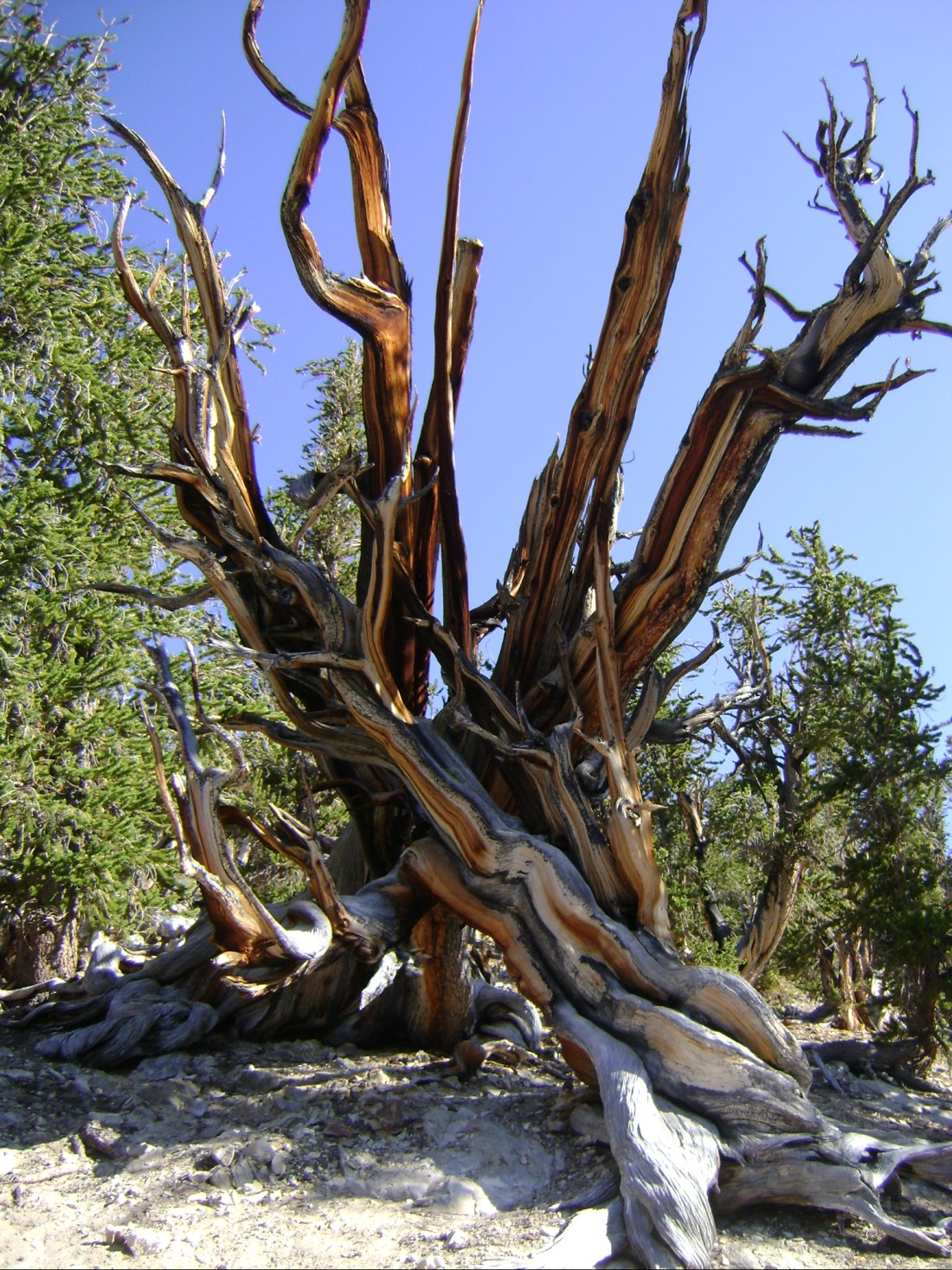
Some of the oldest trees are the bristle cone pines within the White Mountains of California. These trees can live to be over 5,000 years old! I attended a tree ring workshop in that area where we had the chance to visit a bristle cone pine forest and view the wood of these ancient pines. Many trees you are likely familiar with have easily-seen rings. Take a look at a tree stump and you will be able to count the rings. These trees however, grow such dense wood, their rings are almost imperceptible. They also grow extremely slowly. These trees are not huge, most were smaller than what you would see on a hike in the Appalachians. But their wood is extremely durable and able to withstand the intense climate conditions of the dry, rocky conditions in which they live.

Within struggling times when patience is needed, think of the strong trees building wood cells moment by moment at an imperceptible rate. One foot in front of the other.

Rip Currents

At some point or another, I think we have all been pummeled by the waves of life – when wave after wave bashes into us, knocking us down, exhausting us, leaving us feeling like we cannot breathe. Sometimes the waves are external life events (divorce, car accident, illness, etc.), sometimes it is our own minds (internal dialog that is on a negative reel of self-hatred, low self-esteem, worthlessness, etc.), and sometimes both. You pull yourself back up, only to be immediately hit in the face again by a crashing wave. And again and again until you feel like you cannot even try to stand any more. An approach to surviving this onslaught is to stop trying, stop fighting against the waves, let go of the need to stand back up.

This sounds counter-intuitive. It is the opposite of what we hear every day – Fall off the horse, jump back in the saddle. Don’t quit. – But this isn’t quitting or falling, rather it is accepting. It reminds me of rip currents in the ocean.

Rip currents are when powerful, narrow currents of water pull away from the shore. People can drown when caught in a rip current because the force of the water cannot be overpowered by swimming against it, and since the water is flowing away from the shore, the normal reaction is to swim against the current towards the shore. Even strong swimmers cannot overpower rip currents. To survive a rip current, the best approach is to “ride it out” or swim parallel to the shoreline. To swim parallel to the shoreline will hopefully get you out of the grip of the rip current and enable you to get back to shore. In some case, floating along with the current until you are out of its grip and allowing the waves to carry you back to the shore is the best approach, especially if you become exhausted and cannot swim. The hard part is that we want to get back to the shore as soon as possible and fight against the current. This futile action only leads to complete exhaustion.

Similarly to when we find ourselves within the metaphorical waves of life, our natural reaction is to fight against them, but this leads to exhaustion, hopelessness, and depression. If we grab control, stand back up on our own two feet, only to be knocked over again, we may grab even harder for control. Holding onto control is futile. Every wave reminds us that we are not in control, and the illusion and then knock-down plunges us deeper into despair.

So the thing to do is the hardest – let go, accept, stop fighting. Flow with the current knowing that we will not be caught in it forever. Realize that you can breath even when plunged under water. It is uncomfortable. We often panic and fight even harder, but it is futile and counterproductive. In Buddhism, suffering is to not accept what is happening. We need to accept the fact that waves are pounding us in the face, with the realization that we are still breathing. Not by our own strength can we force ourselves to freedom, but by letting go, flowing with the current, and continuing to breath. Eventually, we can then move through the waves with confidence knowing that they will bring us back to the shore.


Hope is Like a Dark Forest

Have you taken a walk through a forest at night with a not-so-great flashlight and the walk you’ve done a thousand times in the daylight becomes a fear-ridden dungeon of bobcats and bears? I am not even afraid of bears, but in my mind, they can be as prevalent as trees when everything becomes a shadow in the shape of a large glob.

I had never thought of hope as a dark forest until the other night. Thousands of other analogies would have come to mind before a dark forest if I had been trying to think of how to describe hope (maybe something along the lines of light, rainbows, flowers, seeds…). But I was not thinking about hope as I walked through the dark. I was thinking about how I did not have enough life insurance in the event of being attacked by a mountain lion.

Thick clouds blocked any potential light from the moon and stars. Usually during the winter, distant lamps and porch lights are visible once in every several steps, but this night, the air was thick with humidity which blocked any horizontal lights as well. I walked part of the way without the use of a flashlight, which was fine. But then I came to a very muddy stretch and did not want to lose my shoes to red clay, so I turned my half-way working pocket flashlight on and scanned my surroundings.

Before focusing on the mud below me, I saw what my eyes immediately registered as a large bear, before reasoning that it was not a bear, only to see another bear a few feet away before realizing it was a tree stump, before seeing a smaller bear (for real this time) in the bushes nearby, then reasoning that it must be a bobcat before my flashlight blinked more brightly revealing it was part of the bush. Before I could finish rolling my eyes at myself, I was certain to have seen some large animal out of the corner of my eye…

Fear made my mind desperate to make shadows and shapes into something distinctive. During the day I would have registered the dark globs as likely part of a bush or the stump or mound left by a fallen tree. I probably would have glossed over the shadows or not-quite-visible features. But in the dark, my mind had to determine what they were, whether or not I was correct. When I could not clearly see what the globs were, my brain jumped to the quickest answer, which seemed to be bears that night.

Then I realized that I am not even afraid of bears or bobcats or the forest. I was in the forest and had to trust that it was still the same forest that it had been hours before when the sun was still up above the horizon. Just because I could only barely see the things immediately around me, did not mean that the forest had changed, just my perspective.

Hope is realizing I cannot seeing the big picture with my dim flashlight but trusting that the forest ecosystem is the forest ecosystem whether or not I can see it. It is not out to get me. There is the entire forest that includes hundreds of trees, mounds of soil, shrubs and fallen trees, and maybe even a bear or a dozen deer within several square miles. It is not just me and the surrounding 20 feet that I convince myself includes a dozen bears and a bobcat or two. My short-sighted perspective allowed fear to ooze into every fuzzily-defined shadow and then my brain had to grad for control by defining exactly what I was not clearly seeing.

Hope is the large scheme of things, larger than what I have seen within my lifetime up to this point or will see within my entire lifetime, no matter how short or long. Hope encompasses uncountable numbers of people and elements and extends beyond our comprehension of time and space. Hope is the trust that this whole thing is coming from somewhere good and going somewhere good, even if we are standing in mud and surrounded by bears.

The Presence of Trees

Have you ever just sat in a forest with your back against a tree? If you can stem the seemingly nonstop chatter in your brain, you may notice the calm quietness that seems to exude from trees. Their quietness asks for quietness in return. The steadiness of a large tree extends beyond the thickness of its trunk, the spread of its roots, and the extension of its branches. It flows throughout the forest.

When faced with overwhelming struggles or heartache, many times, no words can help. The pain pierces the deepest points of our being and words are mere static, babbling background noise that cannot reach the depth of our current existence. But presence can sometimes help when nothing else can. Someone who can hold our pain. Sometime this is a person, sometimes a pet, and sometimes a tree. Sometimes the pain is too much for another person, but a tree can take it and remind us that we also have the steady strength of a tree. Press against its trunk with your back, feel the unyielding pressure. The tree has seen storms blow through, felt the heavy weight of ice on its branches, and slowed its growth when water has become scarce. It cannot take shelter, it cannot run and hide. It must accept the sunny days and windy days, times of ample rainfall and those of drought.

Their scars add depth to their character and winds increase their strength. A raised nub with a hollowed out center may have been a branch that broke off during a storm or died from disease. Lightning strikes leave behind a ridge on the trunk that extends from the ground upwards. Blights can cause large knots to protrude. Twisting and gnarled branches and trunks can indicate a struggle to survive. Some trees are over 100 years old but the thickest part of their trunk could fit within the loop made by your thumb and index finger, their growth stunted by harsh conditions. These trees with the gnarled stems, lightning strike ridges, and scars draw us in like someone with an interesting story to tell. You may have noticed the angled lines within the wood of a tree or limb that has lost its bark. This pattern occurs from winds pressuring the tree over time. In response, the wood within the tree or limb twists and is more flexible than wood with straight grain. The stress works to strengthen the tree.


The Changing Seasons

Spring and autumn are arguably the most beautiful times of the year in the temperate regions of the world. With springtime comes waves of colors – yellows, purples, pinks, whites, and greens. Each day seems to bring out more color as the browns and grays of winter fade into the background. Warmer temperatures cause enzymes within the plants to begin blooming in anticipation of even warmer weather. Light greens creep up the mountain sides, transforming the brown to green a bit more every day. Red buds line highways and speckle hillsides with their bursting pink blooms. Dogwoods unfurl from green to white bracts. Everyday is saturated in newness and brightness, even cloudy and rainy days just enhance the brightness.

Likewise, colors define the fall season. The green palette that we grow accustomed to during the summer transforms to reds, yellows, and oranges. The mountain sides and individual trees appear on fire with color. Cooler temperature trigger this change as the trees prepare for winter.

While spring and fall are both bursting with color and beauty, they are also often the most tumultuous seasons of weather. Spring, as the air temperatures warm with the changing relative position of the sun to the Earth, is the transition from winter to summer in the U.S. In the Northern Hemisphere, the movement of the Earth results in the direct rays of the sun migrating from the equator on the spring equinox (around March 21st) northward, reaching its northern-most extent on the summer solstice (around June 21st). This pattern heats up the Northern Hemisphere during the spring and summer months, as the Southern Hemisphere cools. After the fall equinox (around September 22nd), the sun’s direct rays slide southward, and the Northern Hemisphere cools and the Southern Hemisphere heats up.

These shifts in temperature affect more than whether we need to wear shorts or a coat. Differences in temperature produce changes in air pressure. Air pressure can be difficult to conceptualize. Often, to us, air feels like nothingness – no weight, no resistance. But air actually has varying pressure depending on where you are and temperature patterns. Air pressure is often greatest at the base of a mountain and lower as you hike to the top of the mountain because less air is above you as you get higher in elevation.

A helpful way to think of air pressure is to try to visualize air as a bunch of molecules (little circles or bubbles, if you like, or the plastic balls in a play area). Picture them as filling our atmosphere. If you are beneath all those balls or bubbles, the weight or pressure is greater than if you are near the surface of the balls or bubbles because less molecules would be above you if you are near the top. Air is the same way. At sea level, we have more air above us than if we were at the top of Mt. Everest, and therefore, there is greater air pressure at sea level than at the peak of Mt. Everest.

Temperature also affects air pressure. When air is heated, the pressure increases as the molecules become more active and exert more pressure on their surroundings. Molecules in cooler air do not have as much energy and are less active, and therefore, cause less pressure. As the Earth moves around the sun and the direct (most intense) rays of the sun strike different latitudes, various locations on Earth experience shifts in temperatures, which in turn, affect air pressure. Differences in air pressure generate wind.

(I am going somewhere with this.)

Sooooooo… shifts in global temperature patterns affect air pressure which influences wind patterns which directly affect weather patterns. Therefore, with the transitions of spring and fall and changing temperatures, we often see the most intense weather patterns. In the U.S. during the spring time, winds from the Gulf drive up warm, moist air which collides with cold air still descending from Canada. The collision of these two opposite air masses results in an unstable atmosphere which can generate severe storms, flooding, and tornadoes. In the fall, hurricanes are formed from the warm Atlantic and Gulf waters and wind patterns in place over Africa and the Atlantic. The Great Lakes region sees lake effect snows because the lake water is still warm but the air coming across them is cold, causing heavy snows downwind (e.g. Erie, PA and Syracuse, NY).

We see this paradox of heightened beauty and turbulence in our own lives at times of transition. While times of change can frequently bring about new growth and heightened awareness, it can also be painful and uncomfortable. Springtime storms can blow through a forest and knock down dead trees and limbs, cleaning out for new growth. Likewise, painful or transitional episodes in our own life can blow through, wiping out stuff that we no longer need and refocusing our priorities. If we allow it to.

Unlike trees, however, we often resist what is happening if it is uncomfortable or we don’t want it. It is easier to bury our heads in the sand, push the pain away, or somehow deaden it. Allowing the pain in, however, enables us to deal with it and get through it. It is like riding out a storm, hunker down and feel the lashing winds and pelting rain and the temperature drop from a warm embrace to a biting chill. The alternative is to run from it, but you can’t outrun it forever or it will be the driver of your life.

Allowing yourself to feel the storm and suffer its pain can result in growth if you surrender and allow it to enter. You may be bashed from one side and then the other, feel like you are going to drown in the rain or freeze in the icy winds that follow. Just accept it or at least allow it to happen. You can’t stop the storm.

Afterward, if you allow, your dead branches will be gone and your last remaining leaves from the previous year are blown off. Rain has nourished your roots. It’s not easy afterward but you can experience growth and enrichment in your life as new facets of yourself develop and blossom. You can learn more about yourself and life itself. You will shed those parts of your self that are not doing you any good, not enriching your life. You will find things with deeper meaning that do truly enhance your life and learn to cultivate them instead. You become more compassionate and wiser.
Gifts from a Tree

Doritos bags, Pepsi bottles, and fall leaves added color to the brown forest floor and the dreary rain-filled atmosphere. I was performing fieldwork recently in the pouring rain, which then turned to snow. We were working in a developed area within a city that is not known for its economic prosperity. The site was heavily impacted by human activity and degraded significantly.

Although we were out there to do work to hopefully improve the site, human actions have caused the problems from decade of abuse, misuse, and neglect. The site is littered with trash – broken glass, rusted metal, random plastic electronics; the creek has eroded down to a depth where the banks extend about 9 ft. above the trickle of water; and invasive plant species cover almost the entire area. Recently some agency cut down most trees towards one end of the site.  The cut trees are now lying along side the trees that fell as the stream bank caved into the channel and took the adjacent trees down with it. The stream has likely eroded much of the channel because of development, increased impervious surface in the area, and poor storm water management. The creek itself is small – water did not flow over the toe of my boots and could be stepped across if not for the chasm that it now flows through.

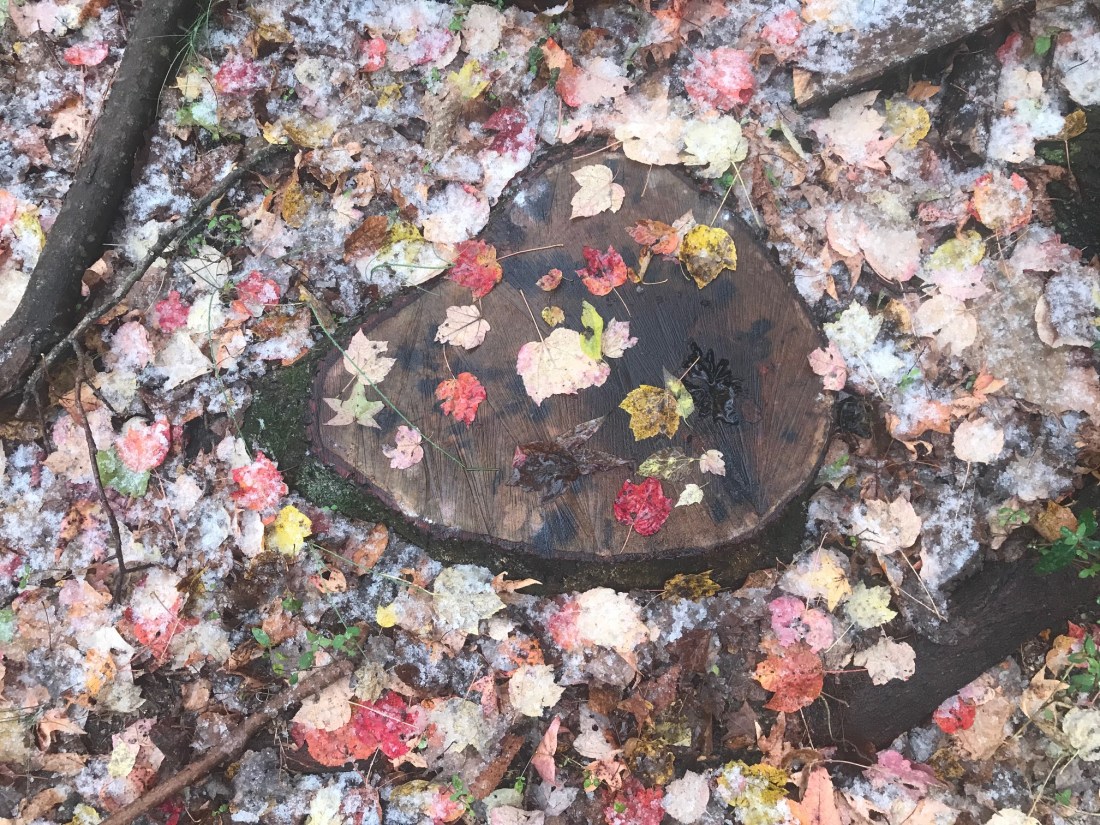
While drenched from the rain and freezing from the sudden temperature drop, I was walking the length of the stream as part of its assessment and came across this beautiful gift. A cut stump was dotted with red and yellow leaves and peppered with snow. The contrast of fall leaves and snow led me to pull my phone out from a pocket beneath my rain jacket. Within the picture, I also noticed that the stump formed a heart shape.

I was struck by such beauty within what I considered a very degraded, ugly site. The tree had been cut down, but its base now served as a palate for the materials falling onto it. Colorful autumn leaves contrasted the bleak brown colors of the stump.

The book The Giving Tree came to mind. Within the story a boy enjoys the many gifts of a tree – shade, apples, company, and then grows up and continues to take what the tree has to offer to the point of cutting it down and using its wood. I find the book distressing. But what has happened is that the tree willingly gave everything it had to the boy/man without any expectation of return. Similarly, this tree at the site lived in rough conditions from human action and then it was cut down. But it still had more to offer and willingly gave more.

This type of giving is what spiritual teachers engender. This outpouring, self-giving love without any thought as to what they may get in return, any accounting. Their internal cup is so full that it spills over and outwards to others. And their cup is filled by realizing and allowing the Divine love to flow into the cup.

I think it can be a common misconception that people give in order to be happy, which is definitely a thing, but many others give because their happiness is overflowing and they yearn to pass their abundance on to others. We often live with a cup that is not even full much less overflowing. This leads to feelings of inadequacy and scarcity. It takes work to get there and work to keep it full (which I assume some people can do?).

When I spend moments in a such a place where my internal cup is approaching fullness, I feel such a sense of contentedness, connection to others, joy, fullness, hope, and freedom. I need nothing and want to desperately to give to others. This is usually after I read and immerse myself in reading spiritual books, scriptures, and meditation or centering prayer. I’m sure there are many ways to get there, but that’s what helps me.

Jesus did not sacrifice himself as much as gave of himself to such an extent that he was willing to die to show us the way. He said eat his body and drink his blood. That is giving in a very visceral, physical, ultimate way.  To do this is to release control. To loosen the grip on our obsessions and small selves. It is complete trust, self-giving, and loving. This type of love has been referred to as kenosis, self-emptying, which does not involve attachment or expectation, but rather purely giving from within.


A White, Red-tailed Hawk

“Dare to be reverent” is found within the Introduction by Evelyn Underhill in The Cloud of Unknowning. What does “reverent” mean anyway? It sounds rather old fashioned and formal, but within the context of that sentence, it sounds almost like a Nike commercial – a confident-inspiring command. “Reverent” means to show or feel deep respect, and synonyms include awe, wonderment, and adoring. A more modernized sentence would be “Dare to be awesome.” Yet that sounds too common and trendy. We hear the term awesome so much its meaning has become numb to us. Reverence may cause a pause because we are not so used to hearing it. And this pause is exactly what we need.

Opportunities for reverence are freely and generously provided by nature as long as we pause long enough to see them or at the very least, put ourselves out in nature.

Feelings of awe and wonder have the ability to push out fear and open us up. One evening while walking through a forested area, thoughts of fear and worry filled my mind and internal dialog. I had agreed to  something but then was having second thoughts regarding if I could actually do it or not, what others may think, and how I would have the time to fit it into my busy schedule. Although I was walking through a wooded area, I did not see the trees around me, the moss and leaves beneath my feet, or the stream flowing nearby. I was blinded by my own fears.

The sound of flapping wings jolted me out of my head. I looked up to see a mostly white-colored red tail hawk landing on a tree branch just ahead of me. It had a few brown feathers on its back and wings, but was predominately white. We do not have many white-colored birds around here, and while I had seen this hawk once before, it was on the opposite side of a field at a far distance and years ago.

The moment I saw it, all fear was gone and I was filled instantly with awe and wonder and excitement and openness to life. This unique bird was so beautiful and rarely seen. There was simply no room for fear or worry. I took the time to stand there watching the hawk as it sat perched on a branch. It then flew to another tree a bit further away, and then another even further in the distance, until I could not see it any more. With each of its movements I was able to see even more details of its unique colors. It was the same size as a typical red-tailed hawk, the eyes were dark, and a couple of brown feathers were on top of its head, a few more along the back, and several scattered within its outstretched wing, but otherwise, the remainder of feathers were a beautiful, clean white color. I was fixated on this bird and can still see it in my memory months later. Not only is the image imprinted to my mind, but also the feelings and experience are still with me. I can think back to the occasion and remember that feeling and how fear instantly evaporated because the wonderment completely filled every instidial space within my being.

I later looked up white-colored red tailed hawks and found out that it is referred to as a leucistic red tailed hark. Being mostly white is a genetic condition that affects a few individuals in the species. It is not albino, which is characterized as all white with non-brown eyes.

Although this white hawk was a rare sighting, nature is full of events and gifts of wonder every day.

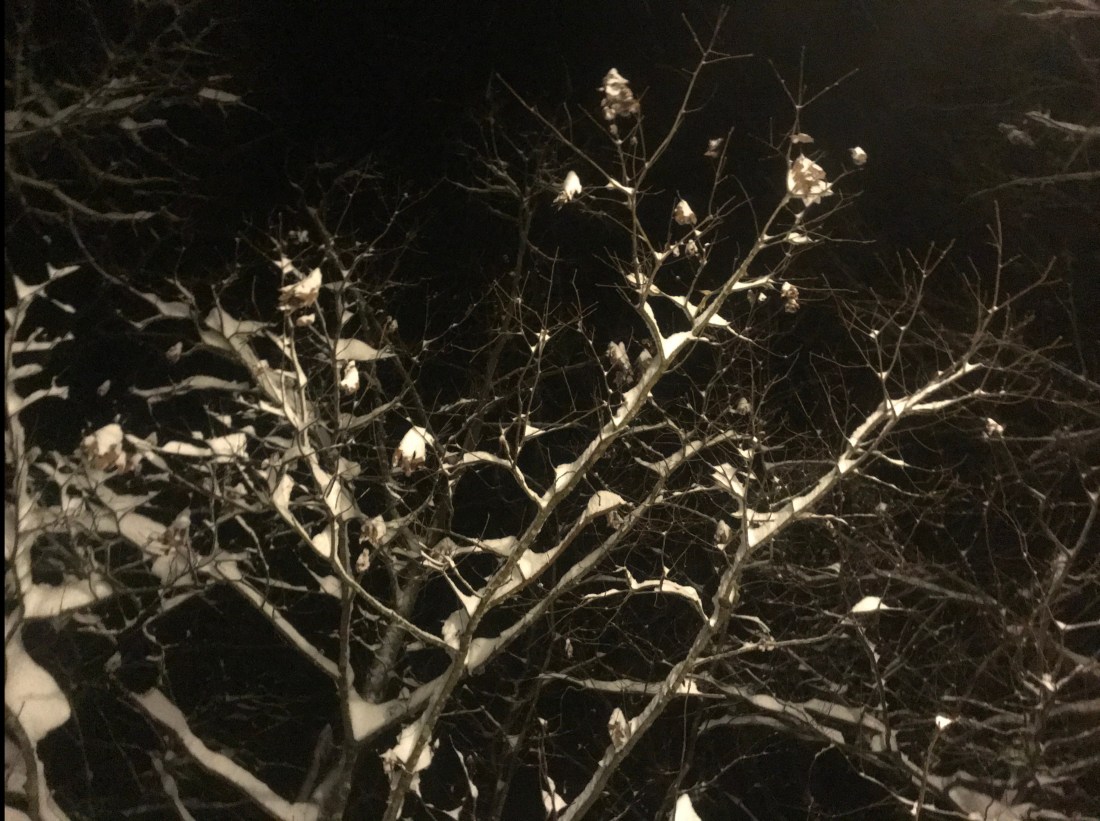
This feeling of openness that we can experience in nature is quite different than what we encounter in our every-day lives. Traffic, emails, and deadlines often have the opposite effect and cause us to close up either in fear, anxiety, or feelings of being overwhelmed. While the feeling of awe is often fleeting, we can encourage the openness that accompanies it to stay and to be experienced a tiny bit more for days or years afterward. We can practice seeing everyday sites with wonder – a flower in bloom, a sunrise, or the many colors present on a dead leaf. Sometimes it is helpful to see these grand things – a white hawk, magnificent mountains, freshly fallen snow on pines – to help get us back on track. We can seek these out or be surprised. They are especially helpful when our mind has run off with worry and fear and obsessions. The primary ingredients for wonderment are slowing down and looking in awareness at something of interest.

Wonder helps us develop relationship with other people, with animals, and the bigger picture. It can plunge our soul into aliveness and gladness. Even if just for a moment, our attention and way of thinking shift. We can cultivate this shift so that it comes more frequently and easily.

We are suffering from a lack of wonderment as a society, a loss of sacredness for the natural world, which spills over into all facets of our life. Without wonderment and a sense of sacredness, we view nature as an object for our benefit or as something hindering our progress or goals. We suffer from a loss of relationship with the rest of the world – nature, animals, other people, and God. Wonderment is a practice that spills over into all facets of life.

What does a life of wonderment look like? Curiosity, openness, acceptance, praise, thankfulness. Awe and wonder can make us feel connected to the whole, a part of something larger, aliveness that springs up from deep within the soul. Wonderment can be a practice on the path of transformation. Wonder cultivates expansiveness, and generates praise.

One of the greatest contributors to experiencing wonder is to slow our bodies and minds down. Wonder surrounds us but we often can’t see it if we are not looking.

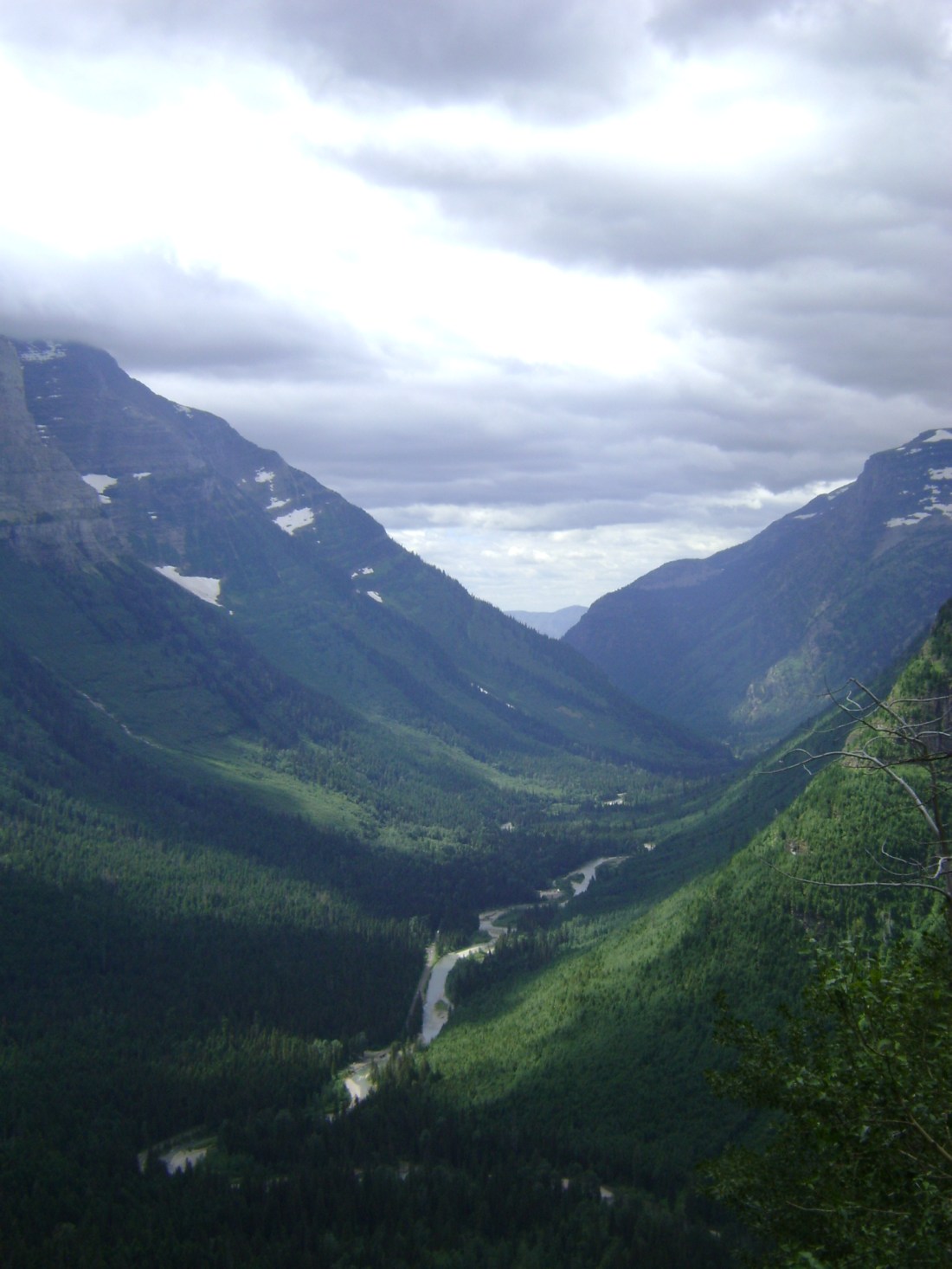
(image: many seek out dramatic mountains for awe-inspiring views)

Thick fog

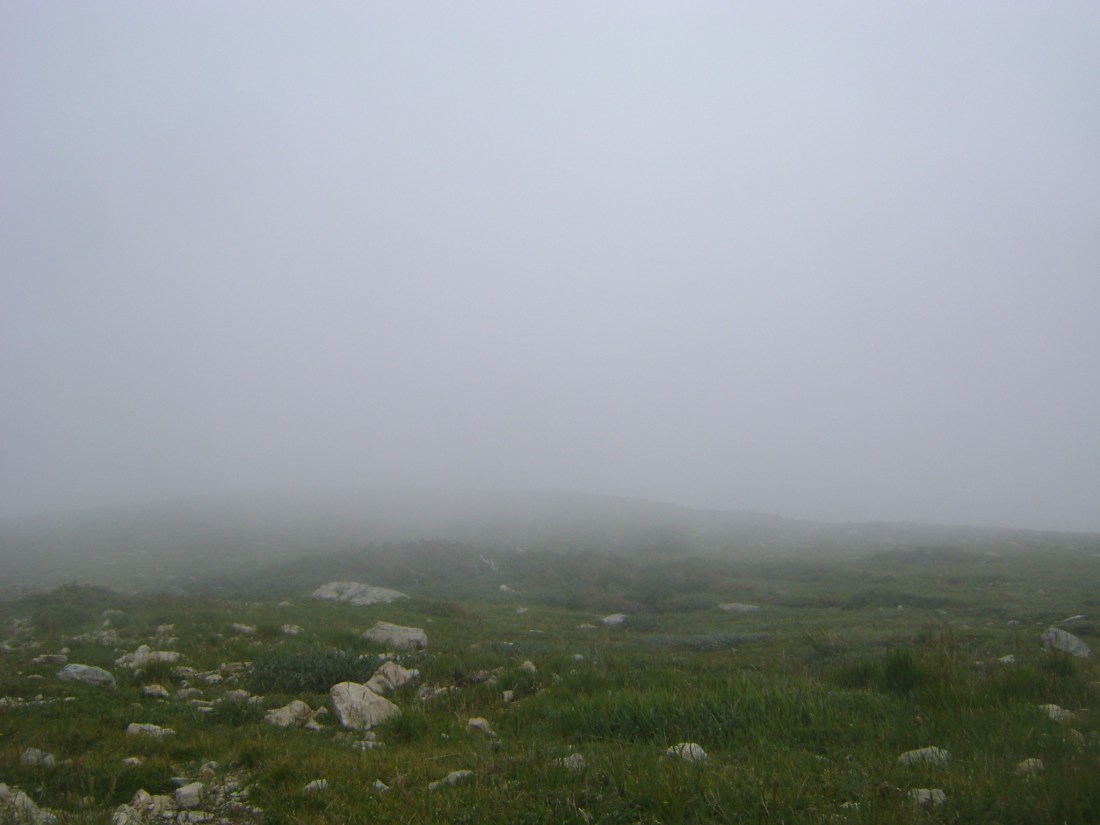
My route to work from home includes driving on winding back roads and over a river before reaching the highway. I usually leave for work before it begins getting light, and today it was also raining with patches of fog. The road slopes down towards the river as it bends through a small valley, continues over a bridge, and then ascends the slightly inclined hill on the other side of the river, a few miles before reaching the highway. On my descent towards the river, the fog was thick and I could only see fuzzily about two feet in front of me. It was uncomfortable to drive in such conditions, but I was thankful that I was familiar with the road and no other cars were close behind me or coming from the other direction. I then had this realization that the discomfort was a familiar feeling, one that served as an undercurrent to my daily being.

I always feel like I am just blindly bumbling along through life. It is even worse than driving through thick fog because in life, we really cannot even see a foot in front of us. We really cannot see in front of us at all, but we trick ourselves into thinking that we can. We make predictions, but we really cannot see beyond the current moment. We can numb that feeling of unease by thinking we know what is coming or by insuring against unseen but predictable events.

And unlike my drive this morning, we have not driven this “road” of life before. While I have an idea of where the curves are on my route to work, I have never been on the path of my life until I am in the current moment. Also, unlike my drive to work, I am constantly surrounded by others who also have not been here previously or can see anything before them.

I think the unease of thinking about this stems from the realization of not having as much control as we think we have. For me, I know I want control, I want to know what is coming and where I am going, and I want to be in the driver’s seat of my life. I plan, I strategize my time, energy, and money to best plan out what I predict is ahead. I cling to things I feel will bring security to my life. But random events and failures have taught me that I really do not have much control in what happens.

As hard as it was, it taught me more than anything else ever has. I am slowly learning to loosen my grip on control and just allowing my life to happen, in other words, getting comfortable bumbling through thick fog.

(Image: fog at 6,000+ feet, mountains of Montana)

Ecotones: Places of Transitions

Where were your favorite spots to play when you were little? Was it is the bamboo thicket at the end of the street? The tree in the front yard? I’ve always been innately drawn to places of transition within nature. They seem the most interesting and obvious. When I was little, I played within the vines and brush that served as a boundary between our lawn and the forest. This space was perfect for building forts and secret places. Another favorite play spot was along the banks of the creek behind our backyard where the forest gave way to the cold flowing water  and boulders of the creek bed. This fascination in boundary areas carried on through my  formal education. I performed research for my master’s thesis on the transition from a forest to a wetland meadow, and my dissertation was on the tree-dotted transition area between the high-elevation alpine meadow and the thick conifer forest below.

The area of transition between two ecosystems or vegetation communities is called an ecotone. Ecotones often are rich in biodiversity because they are a mix of two communities. The extents of vegetation boundaries mingle within this zone. Species are often at the boundaries of their growing limits (which is why the ecotone is there). Conditions may get too wet or dry, too cold or hot, or soil characteristics may change. A species that likes wetlands will find the drier conditions of the surrounding uplands inhospitable. Whereas an upland species will only grow until the soil becomes too wet. At the edge of a wetland, the conditions are somewhat wet and somewhat dry, allowing species that live in wetlands and those that live in uplands to survive. This occurrence results in both the presence of wetland and upland species within the same area, creating a zone that contains more species than found within the purely wetland area or the fully upland area. However, because the species are not situated within their ideal habitat, they are often at their physiological limits.

We also experience times in our lives that are transitions from a place that we are familiar with to a place that is different. These may be changes in jobs or careers, relationships, location, and/or health. Within these transitions, we still carry our old patterns but are also faced with new circumstances. With a change in career, you may find yourself pining for what you loved about your previous job while learning what all the new one entails. A new relationship can be exciting and fun, but comes at the price of certain freedoms and time that only singleness can provide. These transitions are some of the richest in our lives but like the plants living within an ecotone, often-times we feel we are on the brink of what we can tolerate. Change can be uncomfortable and forces us to grow. This is painful and unfamiliar, but brings gifts that life-giving and new (may often be seen only after the fact).

Ecotones extend from very short spans to long distances. The ecotone between a lawn and an adjacent wooded area is often abrupt – grasses growing right up to the edge of trees and leaf litter. Likewise, our times of transition may be quick, but others may take years or decades to fully incorporate. Transitions among biomes (the overall ecosystem of an region) can extend hundreds of miles. Many ecotones are somewhere between the two extremes and extend from a foot or so to several yards. A variety of factors influence how abrupt or gradual an ecotone may be, and similarly, many factors affect the transitions we experience in our lives.  Forced transitions may be painful and drag on for a seemingly unending amount of time. Health problems, layoffs, and break-ups are most frequently experiences that we did not want, and we resist them. Learning to accept what we did not ask for or feel we deserved is a hard process. As we face our “new normal,” we drag our feet or stop altogether. We did not want to be here. We did not ask for this. Acceptance can be a long road with many switchbacks and up and downs, but we eventually can get there. Acceptance will not change the fact that we have an incurable disease or will never be with our ex again, but it allows us to move on and begin growing within the new situation.

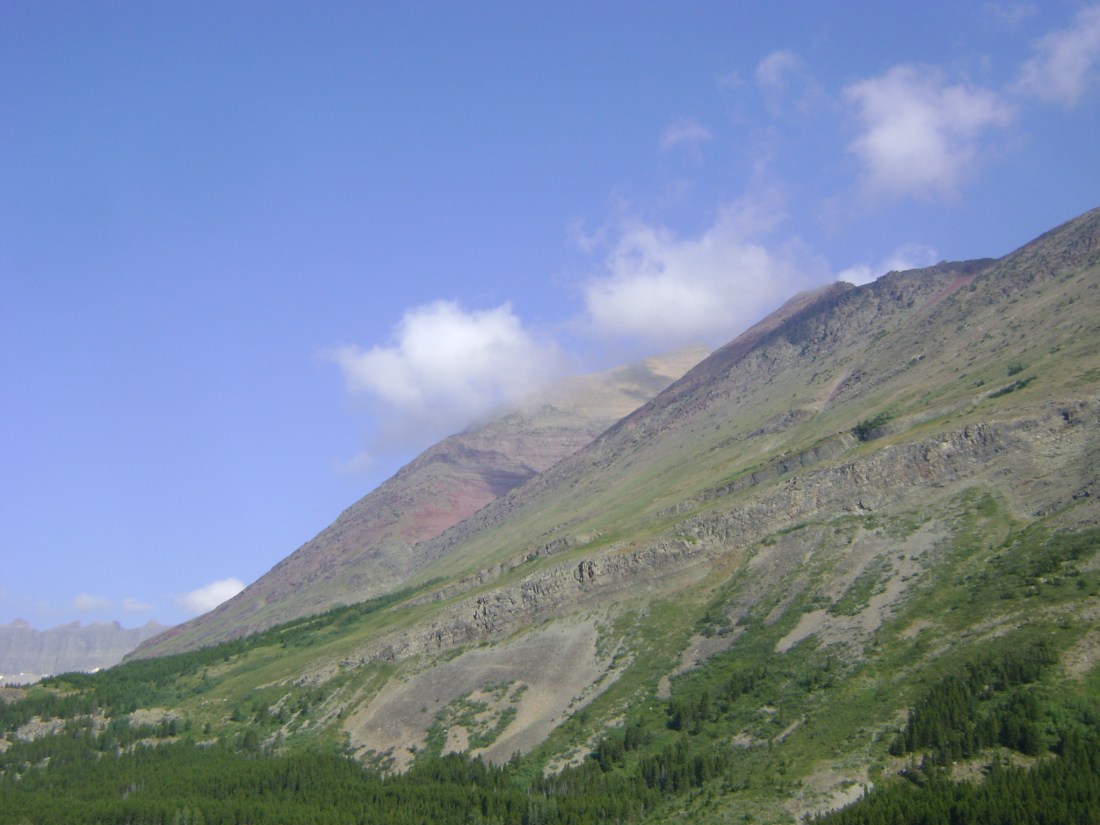
(Image: the treeline ecotone within Montana)