The Changing Seasons

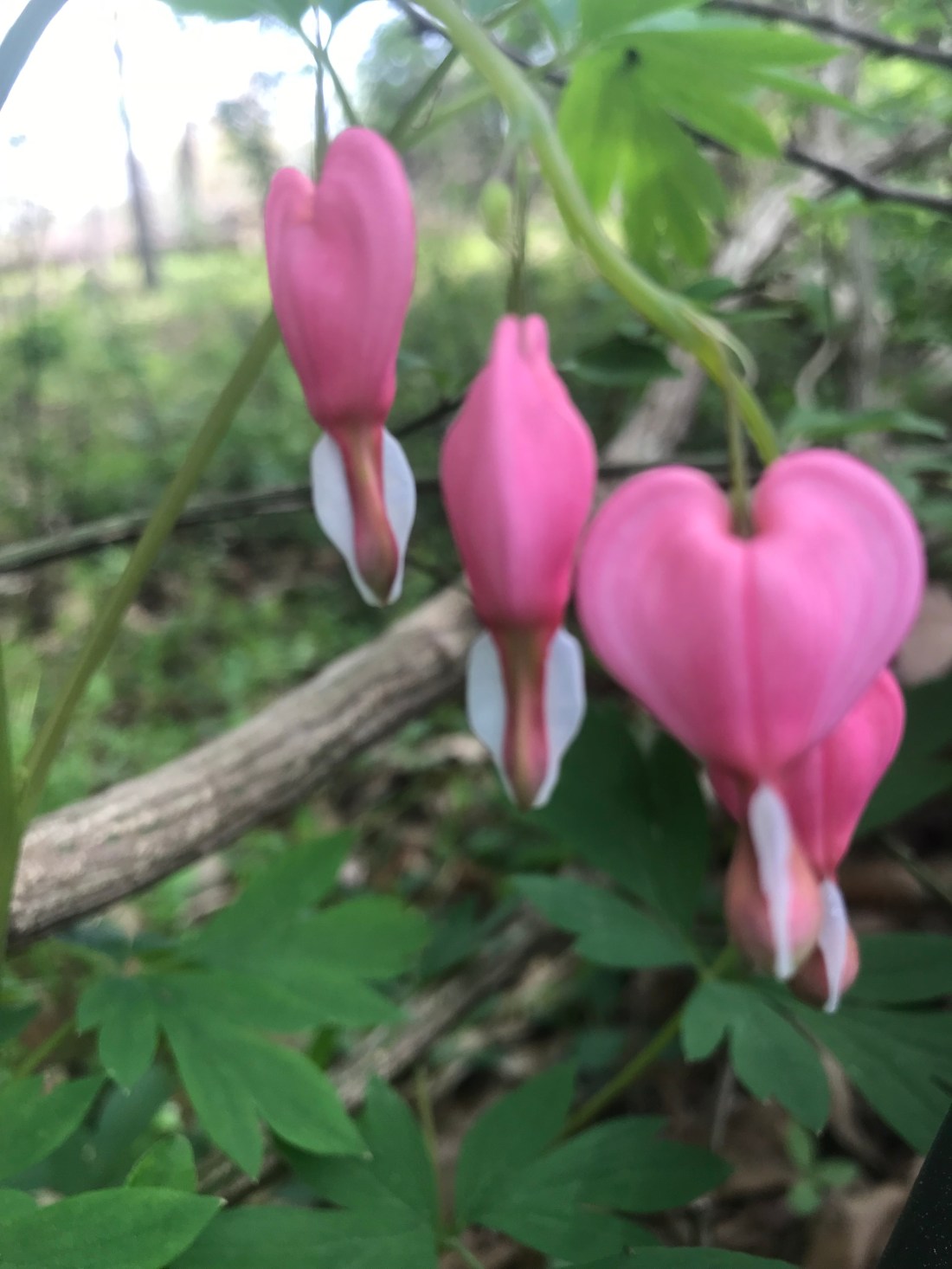
Spring and autumn are arguably the most beautiful times of the year in the temperate regions of the world. With springtime comes waves of colors – yellows, purples, pinks, whites, and greens. Each day seems to bring out more color as the browns and grays of winter fade into the background. Warmer temperatures cause enzymes within the plants to begin blooming in anticipation of even warmer weather. Light greens creep up the mountain sides, transforming the brown to green a bit more every day. Red buds line highways and speckle hillsides with their bursting pink blooms. Dogwoods unfurl from green to white bracts. Everyday is saturated in newness and brightness, even cloudy and rainy days just enhance the brightness.

Likewise, colors define the fall season. The green palette that we grow accustomed to during the summer transforms to reds, yellows, and oranges. The mountain sides and individual trees appear on fire with color. Cooler temperature trigger this change as the trees prepare for winter.

While spring and fall are both bursting with color and beauty, they are also often the most tumultuous seasons of weather. Spring, as the air temperatures warm with the changing relative position of the sun to the Earth, is the transition from winter to summer in the U.S. In the Northern Hemisphere, the movement of the Earth results in the direct rays of the sun migrating from the equator on the spring equinox (around March 21st) northward, reaching its northern-most extent on the summer solstice (around June 21st). This pattern heats up the Northern Hemisphere during the spring and summer months, as the Southern Hemisphere cools. After the fall equinox (around September 22nd), the sun’s direct rays slide southward, and the Northern Hemisphere cools and the Southern Hemisphere heats up.

These shifts in temperature affect more than whether we need to wear shorts or a coat. Differences in temperature produce changes in air pressure. Air pressure can be difficult to conceptualize. Often, to us, air feels like nothingness – no weight, no resistance. But air actually has varying pressure depending on where you are and temperature patterns. Air pressure is often greatest at the base of a mountain and lower as you hike to the top of the mountain because less air is above you as you get higher in elevation.

A helpful way to think of air pressure is to try to visualize air as a bunch of molecules (little circles or bubbles, if you like, or the plastic balls in a play area). Picture them as filling our atmosphere. If you are beneath all those balls or bubbles, the weight or pressure is greater than if you are near the surface of the balls or bubbles because less molecules would be above you if you are near the top. Air is the same way. At sea level, we have more air above us than if we were at the top of Mt. Everest, and therefore, there is greater air pressure at sea level than at the peak of Mt. Everest.

Temperature also affects air pressure. When air is heated, the pressure increases as the molecules become more active and exert more pressure on their surroundings. Molecules in cooler air do not have as much energy and are less active, and therefore, cause less pressure. As the Earth moves around the sun and the direct (most intense) rays of the sun strike different latitudes, various locations on Earth experience shifts in temperatures, which in turn, affect air pressure. Differences in air pressure generate wind.

(I am going somewhere with this.)

Sooooooo… shifts in global temperature patterns affect air pressure which influences wind patterns which directly affect weather patterns. Therefore, with the transitions of spring and fall and changing temperatures, we often see the most intense weather patterns. In the U.S. during the spring time, winds from the Gulf drive up warm, moist air which collides with cold air still descending from Canada. The collision of these two opposite air masses results in an unstable atmosphere which can generate severe storms, flooding, and tornadoes. In the fall, hurricanes are formed from the warm Atlantic and Gulf waters and wind patterns in place over Africa and the Atlantic. The Great Lakes region sees lake effect snows because the lake water is still warm but the air coming across them is cold, causing heavy snows downwind (e.g. Erie, PA and Syracuse, NY).

We see this paradox of heightened beauty and turbulence in our own lives at times of transition. While times of change can frequently bring about new growth and heightened awareness, it can also be painful and uncomfortable. Springtime storms can blow through a forest and knock down dead trees and limbs, cleaning out for new growth. Likewise, painful or transitional episodes in our own life can blow through, wiping out stuff that we no longer need and refocusing our priorities. If we allow it to.

Unlike trees, however, we often resist what is happening if it is uncomfortable or we don’t want it. It is easier to bury our heads in the sand, push the pain away, or somehow deaden it. Allowing the pain in, however, enables us to deal with it and get through it. It is like riding out a storm, hunker down and feel the lashing winds and pelting rain and the temperature drop from a warm embrace to a biting chill. The alternative is to run from it, but you can’t outrun it forever or it will be the driver of your life.

Allowing yourself to feel the storm and suffer its pain can result in growth if you surrender and allow it to enter. You may be bashed from one side and then the other, feel like you are going to drown in the rain or freeze in the icy winds that follow. Just accept it or at least allow it to happen. You can’t stop the storm.

Afterward, if you allow, your dead branches will be gone and your last remaining leaves from the previous year are blown off. Rain has nourished your roots. It’s not easy afterward but you can experience growth and enrichment in your life as new facets of yourself develop and blossom. You can learn more about yourself and life itself. You will shed those parts of your self that are not doing you any good, not enriching your life. You will find things with deeper meaning that do truly enhance your life and learn to cultivate them instead. You become more compassionate and wiser.
The Process of Change

I was fortunate to visit the Grand Tetons in late September for a conference one year. The experience while we were outside was an immersion of the senses. The combination of the smell of burning wood from nearby wildfires and the explosion of fall leaf colors reminded me of the cycles of disturbance and seasons. The autumn colors within the valley were a tapestry of yellows, reds, and maroons that revealed themselves from behind a curtain of thick smoke. The colors were so vibrant that my eyes could not fully absorb the richness and beauty.  The Snake River flowed through the flat valley between dramatically steep mountain sides over smoothed rock making calm gurgling sounds. The water level was shallow since the spring snow melt was months past, but the water was still cold to the touch. The dry shrub crunched underfoot, which released whiffs of sage. I wanted to be there in that unfolding of summer until snow started falling. Like the leaves, however, I could not stay for long. I was only there for a few days and had to attend talks. I’m sure within a week or two those leaves began falling to the ground as the trees prepared for the coming winter.

As temperatures become cooler and the daylight length shortens within the temperate regions (found between the poles and the tropics) of the world, deciduous trees begin preparing for winter. Enzymes, triggered by cooler temperatures, start sealing off the boundary between the woody twig and the base of the leaf stem. As this occurs, photosynthesis stops, and chloroplasts – the cells that cause the leaf to look green and carry out the photosynthesis process – are no longer needed. We see leaves as green because the red and blue wavelengths are absorbed, but green light is reflected. Once the chloroplasts die, however, other colors are reflected, resulting in the reds, yellows, and oranges of autumn. The leaves will then be cut off from the tree and drop to the ground.

This leaf fall process protects the tree during the cold winter months. If the deciduous leaves were to remain alive on the tree, they would be at risk for freezing and would facilitate the accumulation of snow and ice, which could cause limbs to break under the added weight. Leaves during winter would also not be as effective at photosynthesizing  because of the shorter amount of daylight and less direct sunlight, while at the same time they would be losing moisture through the stomata (tiny holes within the leaf). For the health of the tree, the leaves die and fall to the ground before winter. This process also benefits the organisms that live below the tree. Leaves will break down and add nutrients back into the soil. If a stream is nearby, the leaves serve as food to some aquatic organisms. This death and loss actually contributes to new growth. 

Change is often a process, not something that happens within an instant. Leaves do not just pop off of trees. That is usually what we see, our perception of the process, but it actually takes a while for that break between the leaf stem and the tree branch to occur. Enzymes trigger cells to severe the stem from the branch, then those cells have to grow, photosynthesis stops, the tree seals the cut, and then the leaf falls at some point. Some leaves even hold on throughout the fall and into winter, whereas others snap off before the official first day of autumn. Likewise, we can expect some of our “leaves” to rather easily snap off while others will take time.

Practices such as centering prayer, meditation, and mindfulness can help us with this process. We free up space in our heads and hearts when we are able to let go of anger, clinging to control, desiring others’ approval, thinking we are the worst person on the planet, thinking we are the best person on the planet, etc. This process can be quite challenging and take a lifetime of work.

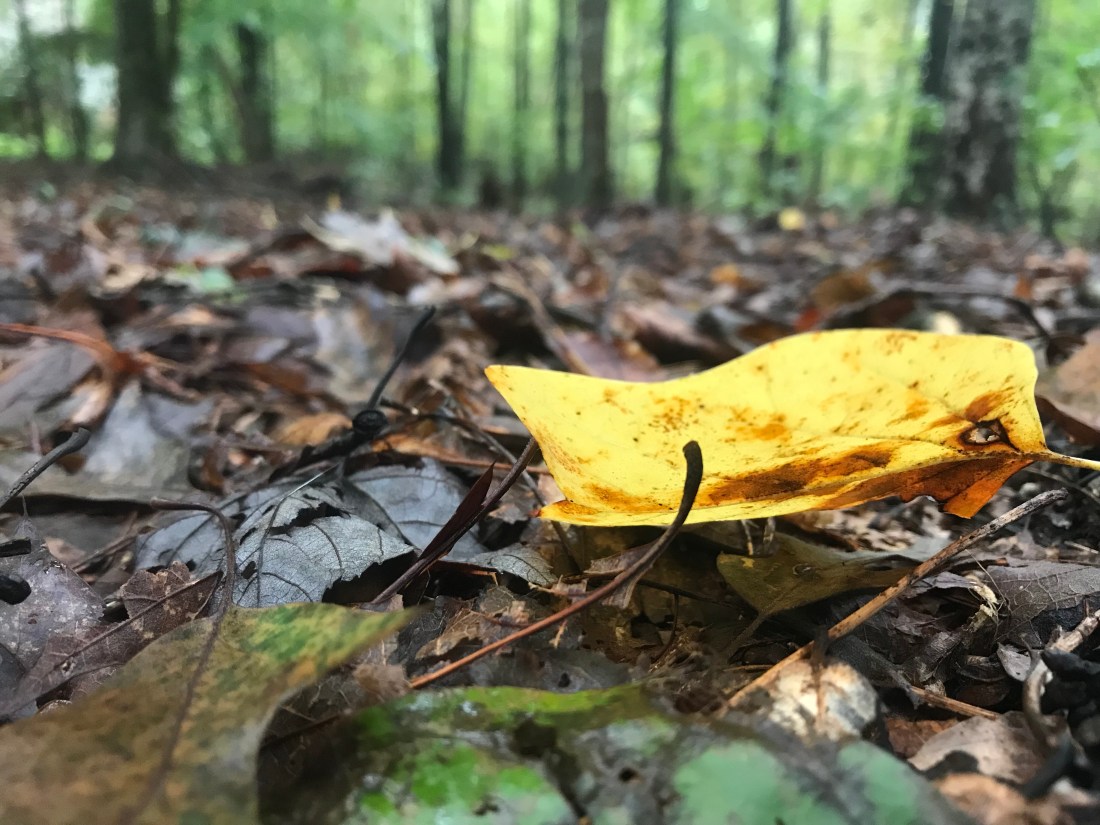
(Image: Tulip tree leaf on the forest floor)

Worn, Torn Leaves

It is early November when the autumn-angled sunlight plays with yellows and reds of tree leaves in a dance of colors. Between the time when summer transitions to fall and fall to winter, the angle in which we receive the sun’s rays shifts closer to the horizon as its more direct rays fall on the Southern Hemisphere. The light, therefore, comes in to a forest or grove of trees from a more oblique angle rather than overhead. As leaves twist in the breeze, the broadside of the leaf catches the sunlight and then passes it to the thin side of the leaf before receiving it again. The leaves at this time of year are not as robust as they once were and hang more loosely to the tree. A light breeze can send them into an energized frenzy of movement or off of the tree altogether.

With such movement, they douse the forest with a show of light and colors. The leaves at this time of the year are also worn and sometimes tattered. Not only is the light reflected on the leaf but holes and tears on the leaf let sunlight through to the forest floor in haphazard bursts. Upon closer inspection, you can see that some leaves have what looks like netting within them where the leaf has largely worn away but the veins are still present. Some leaves are ripped or partially eaten, while others have brown spots from disease or other defects.

They are far from the fresh new leaves of spring. They have weathered storms and converted materials to tree matter using the energy of the sun. They have sheltered birds and served as food to insects.

And soon, the tree will let them go. Much of the time I think we are carrying around stuff in the same way as a tree would be if they kept their leaves year after year. Could you imagine a springtime where leaves would emerge as they were at the end of summer or if they remained in place year after year? Tattered, tough, half eaten, and worn? Even non-deciduous trees drop their leaves or needles yearly so new ones can emerge.

When we hold on to past hurts and pain, or don’t love ourselves, or think we are not worthy of hope and joy, we continue to carry these painful “leaves” around from years ago. They are worn and ripped. We cling to the tattered leaves because we know them and feel as though they are part of who we truly are. The pain can become so embedded, it acts as if we would not be who we are without it. But it is not who we truly are. Letting go and change are hard, even when the things are not good for us.

But letting go frees us and allows for new growth.

As trees let go of their leaves in the fall, we also benefit from letting go of aspects of ourselves that we no longer need or that are not good for us. We cling to so much – stuff, ideas, emotions, images, perceptions – that cloud our spirit and hold us back from growth. One of the big things that many of us hold onto for dear life is control, or rather, the sense of control. We want to be in control of our lives, our futures, our emotions, our thoughts, our circumstances, and it can be easy to perceive that you are in control of all these things.

We can learn from trees by dropping the emotions, motivations, and drives that may have served us well, but are no longer needed. Some of these “leaves” we need to drop may take years to fall away, but we can also practice letting go of the smaller stuff too. When taking a walk outside after work, my mind is often racing with thoughts about what has happened during the day, what I need to get accomplished before night, what I should fix for dinner and I completely miss the dragonfly that lands on the fence line beside me and the sound of papery beech leaves rustling in the breeze. Allowing the thoughts to let go and fall away enables me to remain open to the present moment.

And that is how we can start. Practice catching yourself thinking about the next few hours or what occurred earlier in the day, and many times you may realize that small thoughts fill most of your time. “What did he mean by that comment?” “What if the spot on my shirt was noticeable throughout the entire day? Was it there during my meeting?” “Will I get home in time to fix the chicken or should I just plan on making grilled cheeses?” As these thoughts clutter your mind, the sensations of the present moment pass by unnoticed. The first step is just noticing what you are thinking about. The second step is to choose to come back to the present. How does the sip of coffee taste? Is your office air cold or warm on your skin? How is the sunlight striking the wall or the road in front of you?

Allow leaves to serve as a reminder to you. As you witness a leaf float to the ground, shift your thoughts to the present. As you see leaves from last year piled up against the building, contemplate leaves you may not know you even are hanging on to – past hurts and pains – and how you may go about letting them go (this may take time (potentially lots of time) and talking with friends, a therapist, or a religious leader). I believe this is a life-long process that takes daily effort. Trees lose their leaves every year, it is not a one-time event but rather an ongoing process.

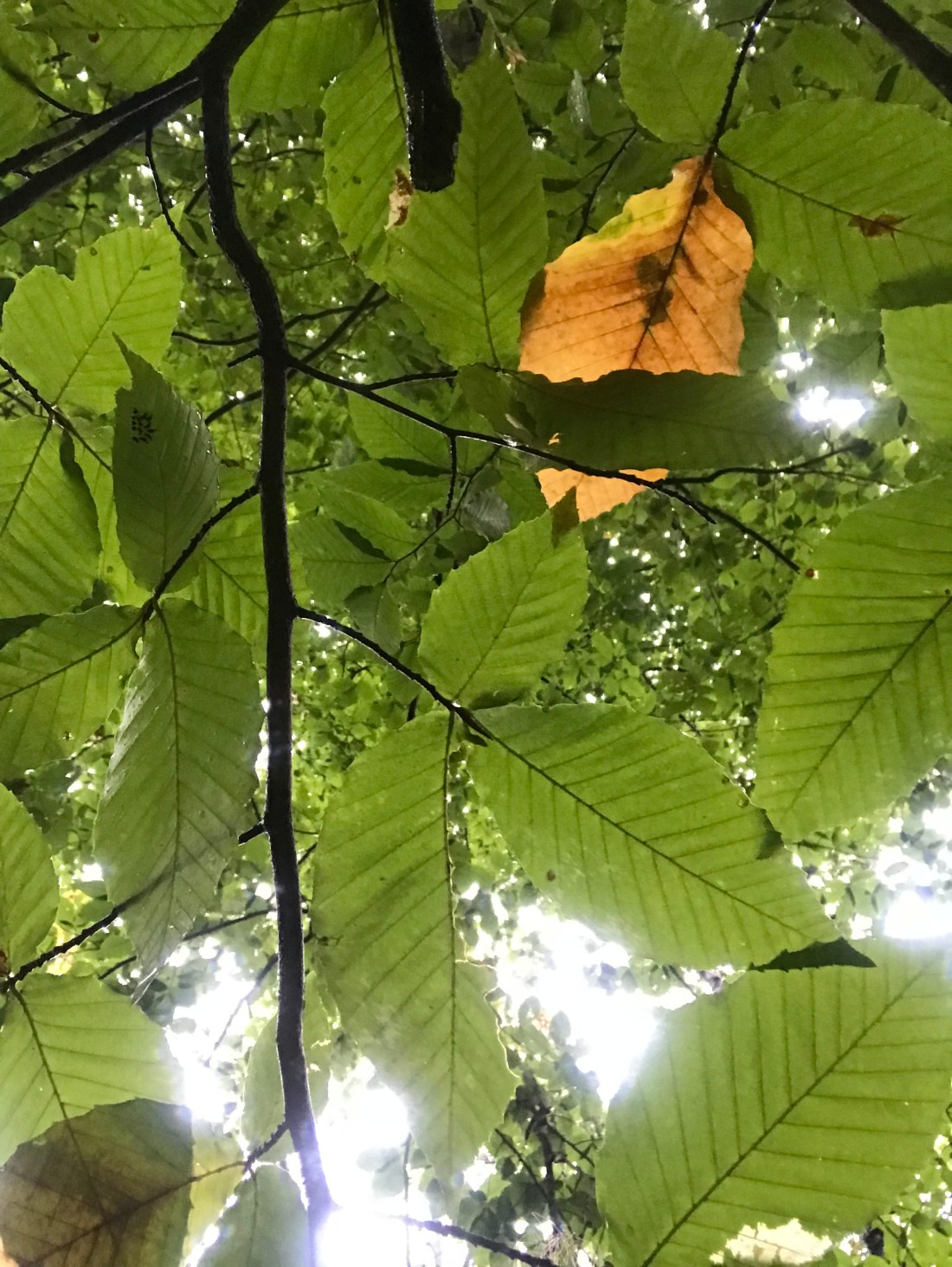
(Image: beech tree leaves)