I was fortunate to visit the Grand Tetons in late September for a conference one year. The experience while we were outside was an immersion of the senses. The combination of the smell of burning wood from nearby wildfires and the explosion of fall leaf colors reminded me of the cycles of disturbance and seasons. The autumn colors within the valley were a tapestry of yellows, reds, and maroons that revealed themselves from behind a curtain of thick smoke. The colors were so vibrant that my eyes could not fully absorb the richness and beauty. The Snake River flowed through the flat valley between dramatically steep mountain sides over smoothed rock making calm gurgling sounds. The water level was shallow since the spring snow melt was months past, but the water was still cold to the touch. The dry shrub crunched underfoot, which released whiffs of sage. I wanted to be there in that unfolding of summer until snow started falling. Like the leaves, however, I could not stay for long. I was only there for a few days and had to attend talks. I’m sure within a week or two those leaves began falling to the ground as the trees prepared for the coming winter.
As temperatures become cooler and the daylight length shortens within the temperate regions (found between the poles and the tropics) of the world, deciduous trees begin preparing for winter. Enzymes, triggered by cooler temperatures, start sealing off the boundary between the woody twig and the base of the leaf stem. As this occurs, photosynthesis stops, and chloroplasts – the cells that cause the leaf to look green and carry out the photosynthesis process – are no longer needed. We see leaves as green because the red and blue wavelengths are absorbed, but green light is reflected. Once the chloroplasts die, however, other colors are reflected, resulting in the reds, yellows, and oranges of autumn. The leaves will then be cut off from the tree and drop to the ground.
This leaf fall process protects the tree during the cold winter months. If the deciduous leaves were to remain alive on the tree, they would be at risk for freezing and would facilitate the accumulation of snow and ice, which could cause limbs to break under the added weight. Leaves during winter would also not be as effective at photosynthesizing because of the shorter amount of daylight and less direct sunlight, while at the same time they would be losing moisture through the stomata (tiny holes within the leaf). For the health of the tree, the leaves die and fall to the ground before winter. This process also benefits the organisms that live below the tree. Leaves will break down and add nutrients back into the soil. If a stream is nearby, the leaves serve as food to some aquatic organisms. This death and loss actually contributes to new growth.
Change is often a process, not something that happens within an instant. Leaves do not just pop off of trees. That is usually what we see, our perception of the process, but it actually takes a while for that break between the leaf stem and the tree branch to occur. Enzymes trigger cells to severe the stem from the branch, then those cells have to grow, photosynthesis stops, the tree seals the cut, and then the leaf falls at some point. Some leaves even hold on throughout the fall and into winter, whereas others snap off before the official first day of autumn. Likewise, we can expect some of our “leaves” to rather easily snap off while others will take time.
Practices such as centering prayer, meditation, and mindfulness can help us with this process. We free up space in our heads and hearts when we are able to let go of anger, clinging to control, desiring others’ approval, thinking we are the worst person on the planet, thinking we are the best person on the planet, etc. This process can be quite challenging and take a lifetime of work.
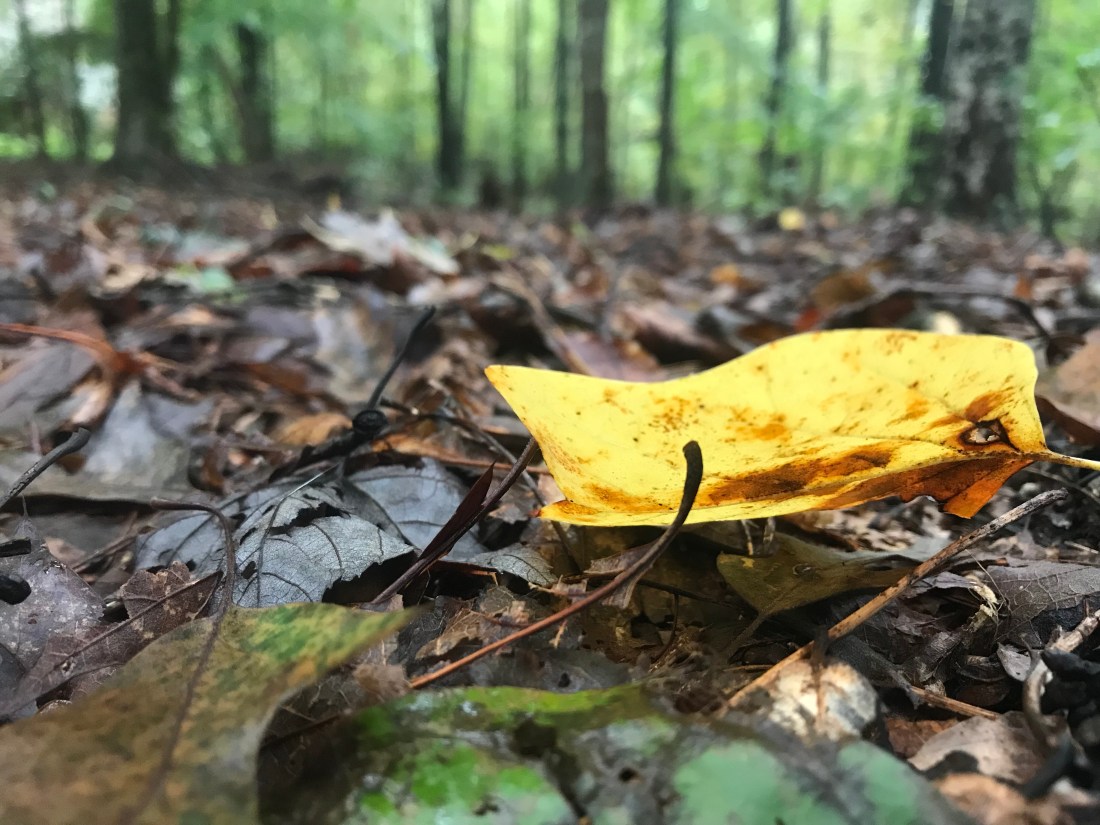
(Image: Tulip tree leaf on the forest floor)
 Nature is Sacred